
Mislocation of Mind
On the Logical Limits of Neuroscientific Explanation...

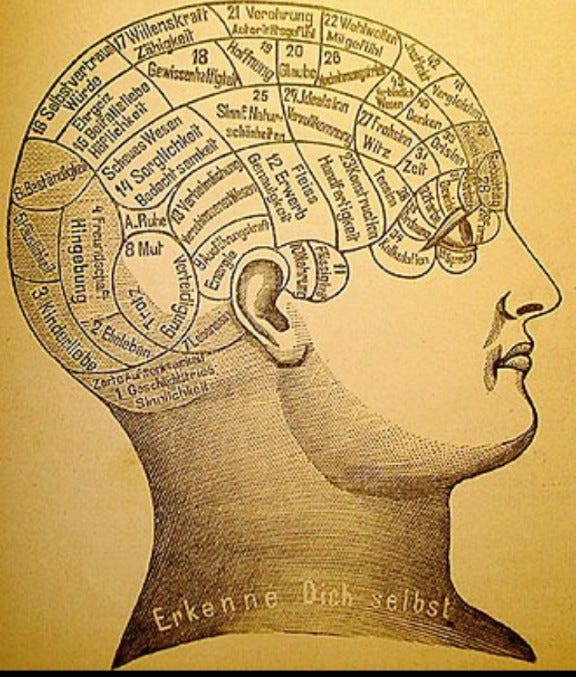
It is, nowadays, quite common to say that beliefs, desires, memories, and decisions are brain states. The claim is presented as the natural culmination of a scientific trajectory: as our knowledge of neural mechanisms increases, the mind is progressively located within the brain. What was once described in psychological terms is now redescribed in neurophysiological ones. The expectation is that, at some point, the former will be replaced by the latter.
The difficulty is not that the science is incomplete. It is that the claim, as it stands, cannot be made sense of.
Consider a simple case. A subject is said to believe that it will rain. What fixes the application of that predicate? Not a scan, not a measurement, not a pattern of neural activation taken in isolation. The predicate is judged to apply in cases where the subject takes an umbrella, consults the forecast, expresses expectation, alters plans, and so on. These are not symptoms from which a further underlying state is inferred. They are the criteria under which the concept of belief is intelligible at all.
Now suppose a neuroscientist identifies a pattern of neural activity that reliably accompanies such cases. The pattern is stable across trials; it can be detected, perhaps even induced. The temptation is immediate: this pattern is the belief. The subject believes that it will rain because this neural configuration is present.
But what licenses that identification?
Take the same pattern, considered independently of the behavioural criteria. Does it, by itself, determine that the subject believes that it will rain rather than that it will not rain? Does it determine that the subject is expecting rather than imagining, recalling rather than supposing, deciding rather than hesitating? It does not. The pattern, as a physical configuration, is indifferent to these distinctions. It becomes one rather than another only when it is placed within a behavioural context under the relevant criteria.
The direction of dependence is therefore fixed:
We do not identify the belief by first identifying the neural state.
We identify the neural state as a belief by reference to behaviour.
This is not a contingent limitation. It is constitutive. Without the behavioural criteria, there is no basis for applying the predicate at all. A pattern of activation, however precisely described, is not self-interpreting. It does not come labelled as belief, desire, or decision. Those labels are applied within a practice that already distinguishes between these cases.
The point can be put without remainder:
Nothing in the brain, taken in isolation, determines the application of a mental predicate.
This is not to deny that neural states are necessary for psychological life. Nor is it to deny that correlations can be found, or that interventions can be effective. One may show that a certain region is active when a subject recalls a list, that disrupting it impairs performance, that stimulation restores it. These are genuine findings. But the interpretation of the activity as recall—as memory rather than perception, as remembering rather than imagining—remains anchored in behavioural criteria.
The neuroscientific description and the psychological description do not stand in a relation of discovery and replacement. They stand in a relation of dependence. The former is mapped onto the latter. The mapping is not read off the brain. It is imposed by the conditions under which we apply our concepts.
This dependence extends to the evidential basis of the science itself. The correlations on which neuroscience relies are not given independently of psychological description; they are established by means of it. A subject is classified as remembering, deciding, perceiving, or expecting on the basis of behaviour—what they say, do, and respond to under specified conditions. Neural activity is then recorded and correlated with these classifications. But the classification is not derived from the neural data; it precedes it. Without the prior application of psychological predicates, there is nothing to correlate. The experiment does not reveal that a certain pattern of activation is memory; it records that, when we apply the predicate ‘memory’ under established criteria, this pattern tends to occur. The correlation is thus anchored in the very practice it is later invoked to explain. The supposed explanans is fixed by the explanandum.
A further constraint follows from the possibility of multiple realisation. The same psychological predicate may be correctly applied across organisms whose underlying physical organisations differ, sometimes markedly. What matters, for the application of the predicate, is the pattern of behaviour under the relevant criteria, not the particular configuration by which that behaviour is produced. It follows that no fixed neurophysiological condition can be necessary for the application of a given psychological predicate, nor sufficient for it in the absence of those criteria. The prospect of strict laws linking the psychological to the neural is therefore excluded in advance. At most, one obtains correlations within a given class of organisms under specified conditions. But these do not generalise to the level at which psychological concepts are applied.
The illusion of explanation arises from a familiar sequence. Behaviour is first described under a psychological concept. Neural activity is then correlated with that behaviour. The correlation is stabilised, refined, and perhaps manipulated. Finally, the neural activity is said to be, or to realise, the psychological state.
But nothing has been added. The criteria that fix the application of the psychological concept remain unchanged. The neural description tracks those criteria; it does not determine them. To say that the belief is a brain state is to take a correlation and treat it as an identity. The move appears substantive; it alters our description, not what is described.
The point can be made more sharply by considering variation. Suppose two individuals exhibit indistinguishable behaviour under the relevant criteria. They answer the same questions, make the same predictions, act in the same ways. By those criteria, they share the same belief. Now suppose that their neural configurations differ—perhaps markedly, perhaps in ways we do not yet understand. Does this difference alter the application of the predicate? It does not. The belief remains the same.
Conversely, suppose two individuals share an identical neural configuration, but differ in behaviour—one takes the umbrella, the other does not; one asserts, the other denies. Do they share the same belief? By the criteria, they do not. The neural identity does not fix the psychological identity.
In each case, the verdict is determined by behaviour, not by neural state. The brain does not supply the criterion.
What, then, becomes of the explanatory ambition? If neural states do not fix the application of psychological predicates, in what sense can they explain them?
The answer is limited but clear. Neural descriptions can feature in explanations of how behaviour is produced, how it varies, and how it can be altered. They can assist in the identification of mechanisms, the tracing of pathways, and the support of interventions. But they cannot—qua neural descriptions—explain what makes a state a belief rather than a desire, a memory rather than an imagination, a decision rather than a reflex. Those distinctions must already be in place before the neural description can be discerned.
To insist otherwise is to mistake a change in vocabulary for a discovery. The substitution of ‘neural activation pattern N’ for ‘belief that p’ does not tell us what belief is. It tells us that, under certain conditions, we apply the predicate ‘belief that p’ when pattern N is present. The explanatory force lies in the correlation, not in the identification.
This is why the project of ‘reading off’ the mind from the brain cannot succeed. There is nothing in the brain to be read in that way. There are processes, structures, and dynamics. There are patterns that covary with behaviour. But there are no inscriptions of belief, desire, or intention waiting to be deciphered. The brain is not a text in that sense.
The limit is not empirical. It is logical. The application of mental predicates is governed by criteria that are not themselves neurophysiological. No increase in resolution, no refinement of technique, no accumulation of data can alter this. One may learn everything that anyone could know about the brain without thereby understanding what makes a state a belief, a desire, or a feeling.
The conclusion follows without strain:
Mental predicates are applied under behavioural criteria.
Neural states do not, by themselves, admit of an explanatory interpretation of those criteria, and so cannot fix their application.
Therefore, mental predicates cannot be read off neurophysiological conditions.
This does not diminish neuroscience. It clarifies its scope. It studies the conditions under which behaviour occurs and can be modified. It does not disclose the content of the concepts under which that behaviour is understood as action.
The mind is not hidden in the brain, waiting to be found. It is discernable in just two ways: in the first-person application of its concepts, and in the practices through which we recognise and respond to one another. To look for it elsewhere is not to pursue a difficult discovery, but to misidentify what is to be explained.